
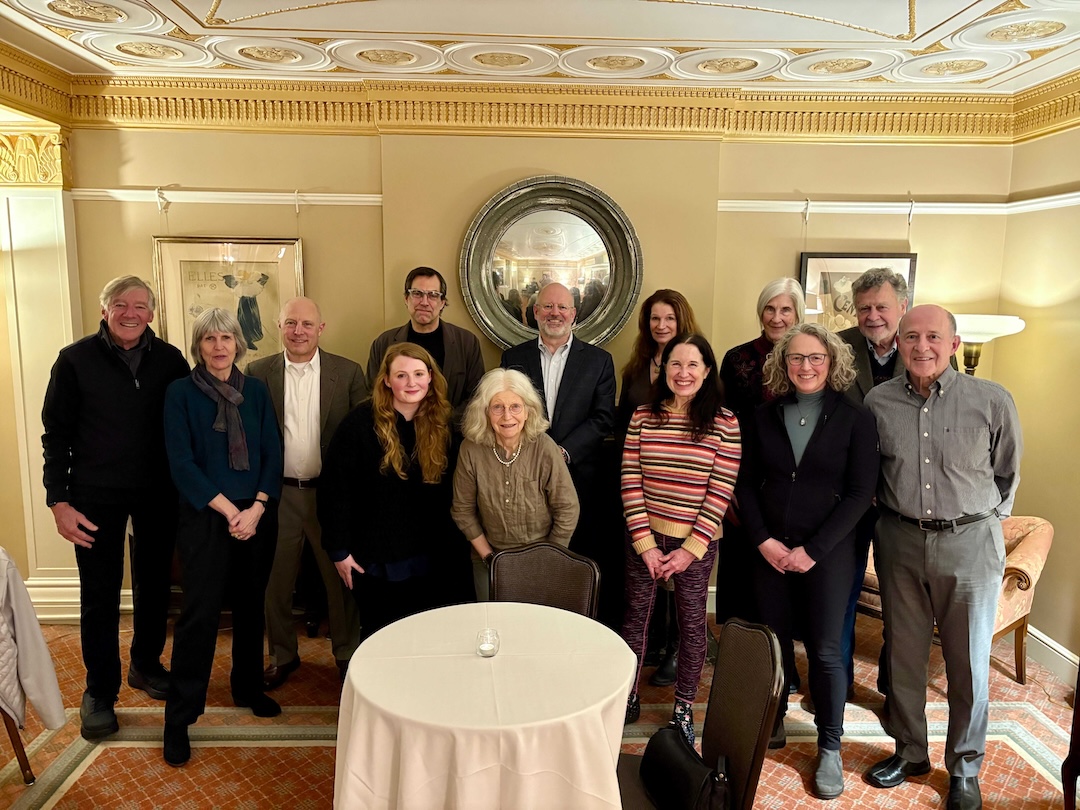
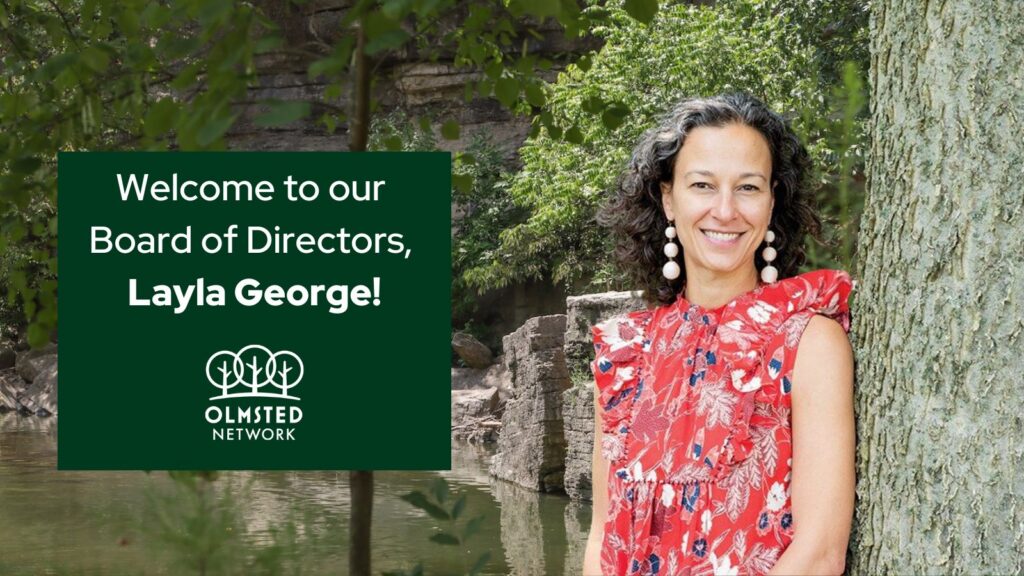
The Olmsted Network is thrilled to welcome Layla George to our board of directors. George led Louisville’s Olmsted Parks Conservancy for seven years, during which she expanded its staff, diversified the board, and grew fundraising. She now heads the ambitious redevelopment of Louisville’s Belvedere and byGeorge Consultants.
As a 7-year President and CEO of the Olmsted Parks Conservancy, you helped to grow its organizational capacity across the board, whether by expanding its staff, diversifying its governance, or dramatically increasing its funding. How does this experience inform your service on the Olmsted Network’s board?
Olmsted Network has been a critical partner to Olmsted Parks Conservancy, especially when COVID hit and we were all struggling to keep our spaces open and safe for everyone. They provided a community and network that I relied on during my entire tenure. Joining the board as the former head of a partner organization gives me a unique appreciation for the role the organization can play across the country.
In more practical areas, I have experience running a non-profit and the various hats that go along with that such as governance, fundraising, finance, strategic planning, and external relations. All those skills are useful in advising Olmsted Network leadership as we work to grow this non-profit organization and expand the service we provide to partners across the country.
How were you first introduced to the work of Frederick Law Olmsted?
Like many, I knew that he designed Central Park and the Biltmore, and being a Louisvillian, I knew he designed our park system. I had read Erik Larson’s The Devil in the White City and knew of his role in the 1893 World’s Fair. I had a general understanding of his outsized role in American landscape architecture.
When I took the job at Olmsted Parks Conservancy, I immersed myself in everything I could read about him. I deeply appreciated that he was a staunch abolitionist and the preeminent writer on slavery during his time, even taking a leave from his beloved Central Park to compile his writings into The Cotton Kingdom in an effort to sway the American public. His legacy was impressive and expansive.
I became fascinated by the bold vision that he had for his parks and the role that they could play in society. Olmsted focused on creating these public spaces for the common man – not the wealthy who had country homes to escape to, but the city dweller who suffered from dirty air and cramped living conditions. These parks were meant to serve as an escape and respite for everyone, and that is still the role they play to this day.
Today you’re the Project Executive for the redesign of Louisville’s Belvedere. Is your work on this green space—which is not an Olmsted landscape—influenced by any particular Olmsted philosophies?
One of my favorite quotes about Olmsted is by the writer Adam Gopnik, who summed it up by saying “Olmsted has a double legacy. On the one hand, he’s a super pragmatist; he’s a problem solver. At the same time, he’s a dreamer. What his parks are all about is finding immensely practical solutions to the problem of building a dream in the middle of a city.”
I think about the way he constructed his parks to mitigate environmental conditions and make the city more favorable for city life – whether by controlling water or traffic. Then to layer on this incredible landscape that serves to physically and emotionally separate people from the harsh realities of urban life, it’s utter brilliance.
And while the design for the Belvedere is not necessarily what one might call Olmstedian, the way it functions and the role it plays, definitely take inspiration from Olmsted. He believed that parks should serve everyone, they should be an escape, they should foster connection and strengthen democracy. I hope to capture and elevate those same ideals in this newly revamped public plaza.
Do you have a favorite area in Louisville’s Olmsted park system?
So many! I am a trail and woods gal, myself, so if I can escape among the trees, that is my happy place. The trails at Cherokee Park are the most accessible to me, the trails at Iroquois Park offer me a longer bit of time in the woods and a lovely native meadow, and the most special walk in the whole system is the Riverwalk at Shawnee Park. It’s at a lower elevation than the rest of the park, so it feels like its own world under the canopy of huge hickories right along the Ohio River. It is just magical.
In a few sentences, please explain why you feel Olmsted’s parks and principles are still important today.
I actually think they are more relevant today than they ever have been. 2020 brought the COVID pandemic and racial justice protests in communities across the country, including Louisville. It was unquestionably a stark reminder of the importance of our parks and public spaces. They became sanctuaries for people to be together, to escape, to exercise, to gather, and to protest.
I believe that summer was the moment when Olmsted’s romantic and lofty vision of a public park was most fully realized.