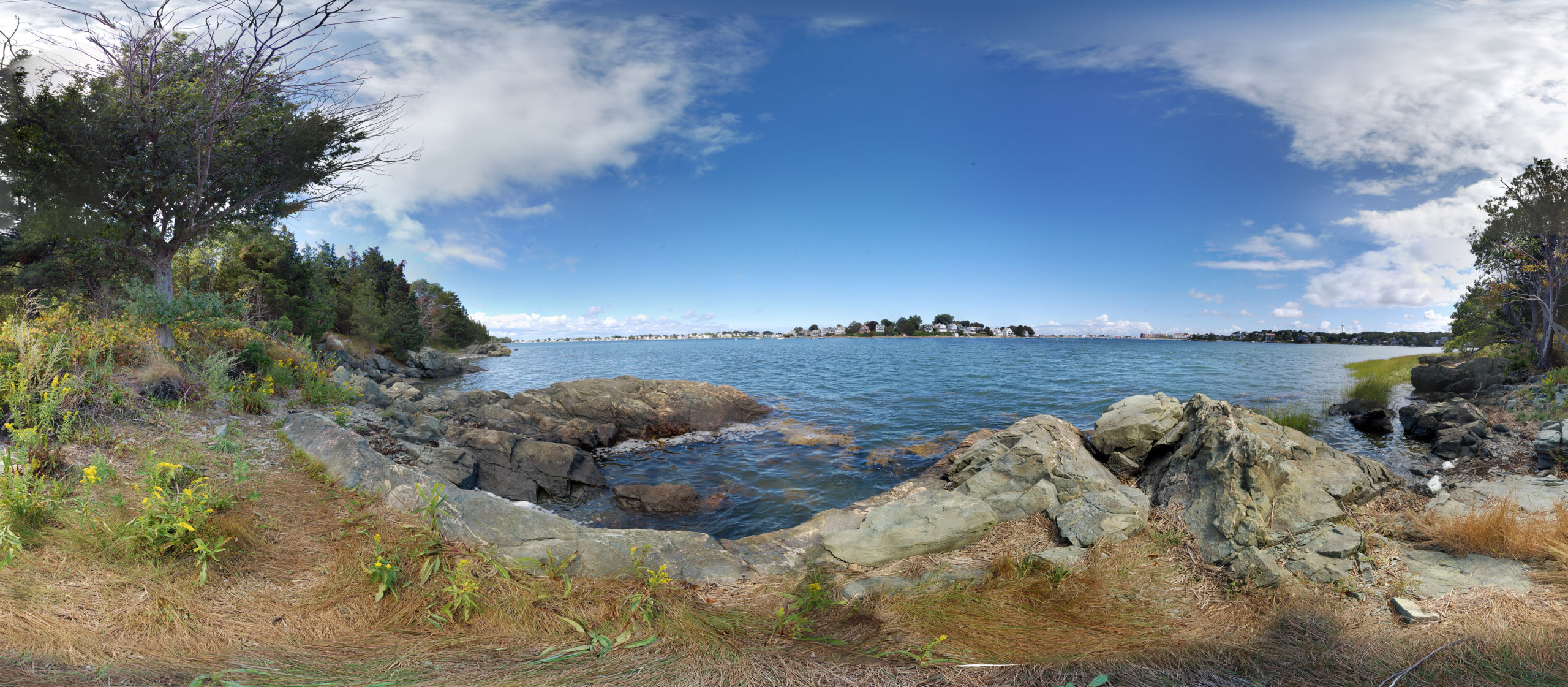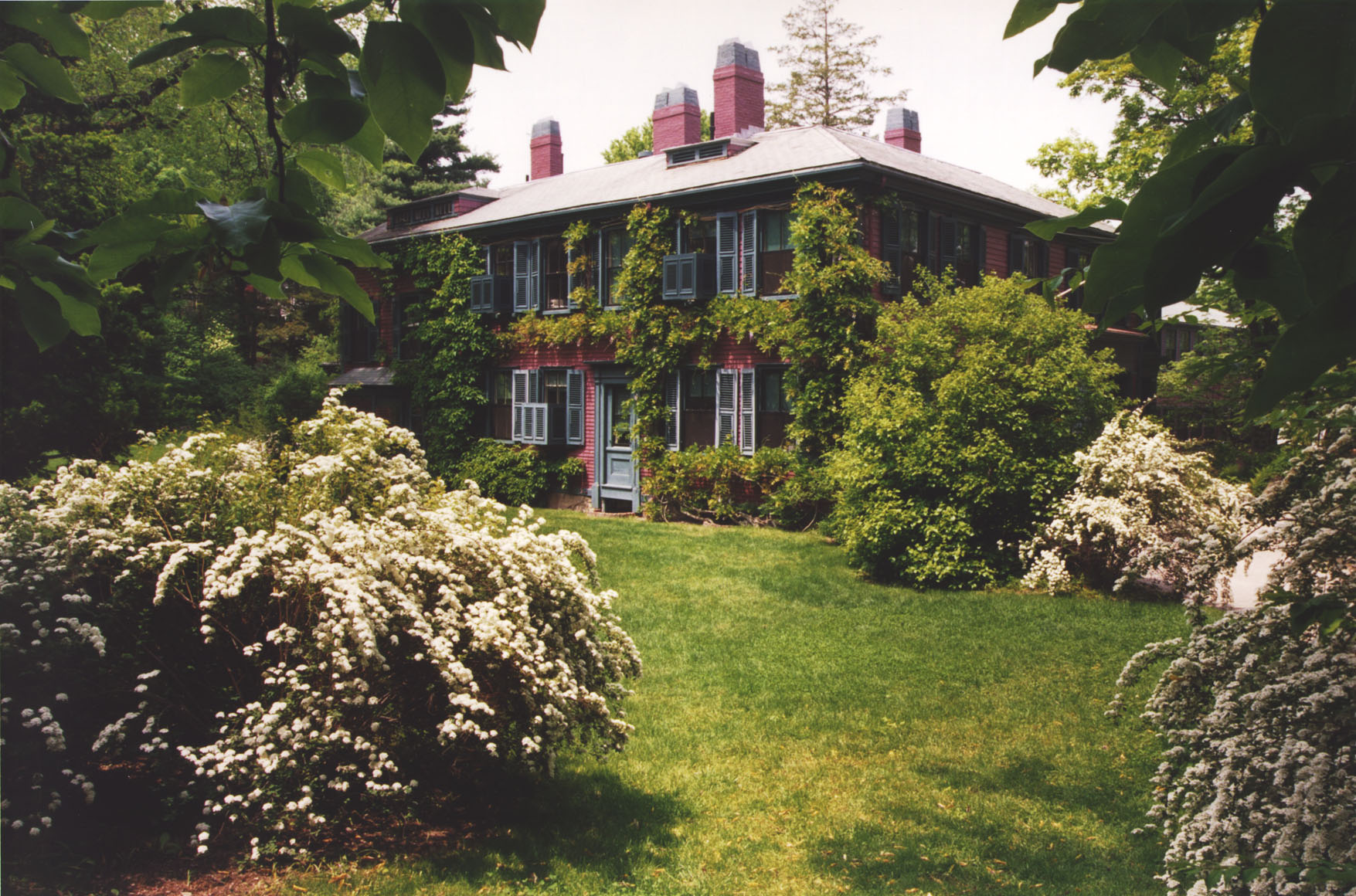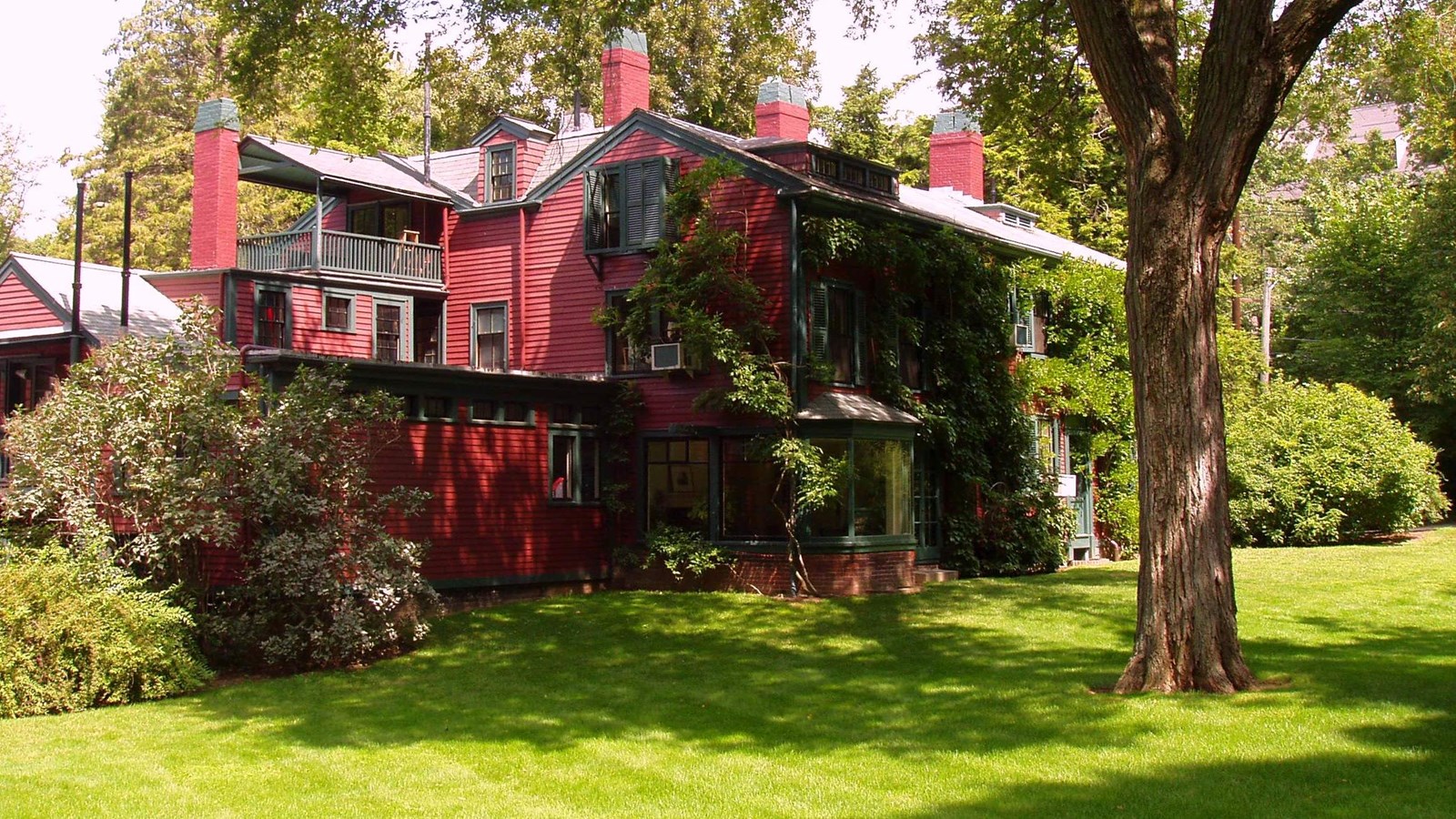

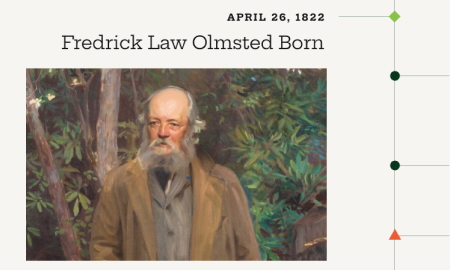
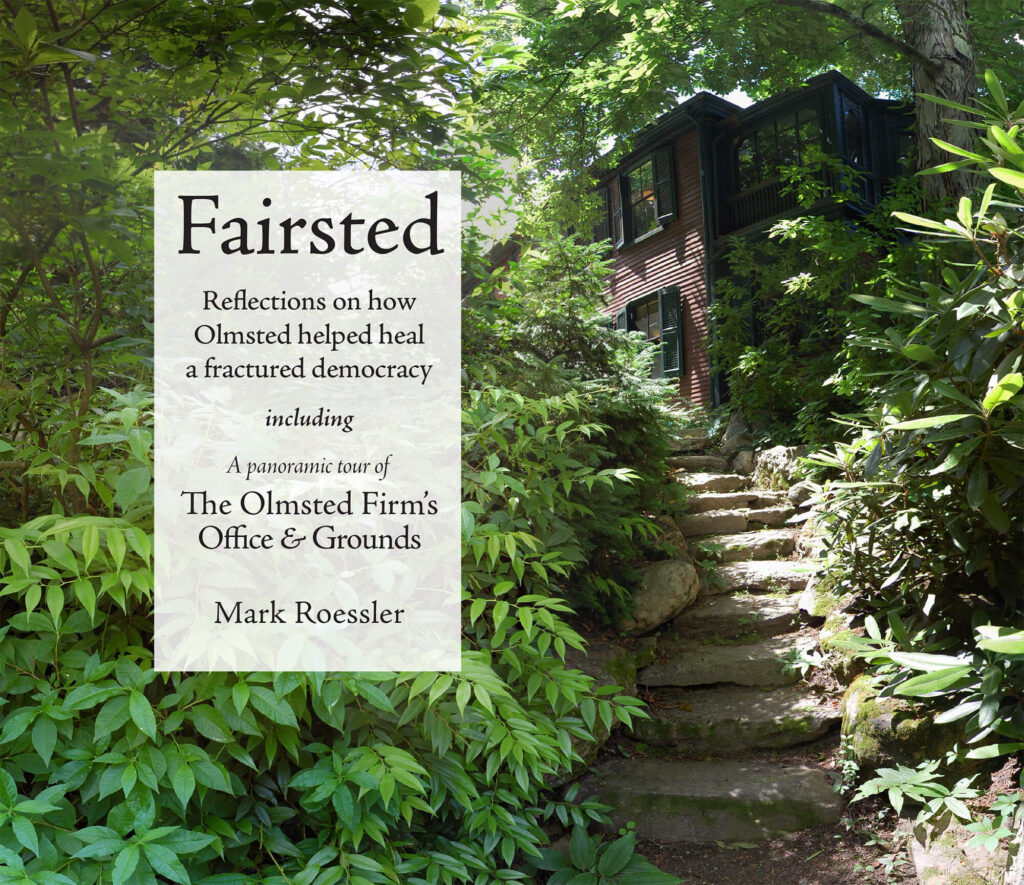
This year, Levellers Press published a new book taking readers inside the workshops and archives of Frederick Law Olmsted National Historic Site, illustrating the inner workings of the Olmsted firm. “Fairsted: Reflections on How Olmsted Helped Heal a Fractured Democracy” by Mark Roessler features detailed panoramas of several areas of the Fairsted office and grounds, alongside companion essays that provide an overview of the ways that Olmsted’s parks achieved their democratic effect. The Olmsted Network recently sat down with Roessler to discuss his work.
1. What first drew you to Fairsted as the focus of this book, and how did it shape the ideas you explore?
About 10 years ago, I got it into my head that I wanted to visit and document all of Olmsted’s parks with my panoramic tours. As an independent reporter, I wanted to capture how his work and legacy evolved. I wanted to take my interest beyond historic documents and park plans out into the current day world.
Fairsted seemed the ideal place to start that journey. So many of the writings I admired were written by Olmsted there, and so many parks were designed in those offices.
Beyond the thrill of visiting a place I’d only imagined, going to Fairsted was my first encounter with others who shared my homespun interest and passion for Olmsted’s work. From the moment Park Ranger Alan Banks agreed to give me access and show me around, I’ve found Olmsted scholars to be generous and eager to share their work. Learning about their perspectives and areas of interest has helped me understand how I might fit in.
2. The book includes a panoramic tour of the Olmsted firm’s office and landscape. What was documenting those spaces like for you?
Though I’d seen some pictures, I still expected to find Fairsted to be imposing. Maybe kind of stuffy. I was thinking of Biltmore near Asheville, NC, or some of the ocean-side mansions in Newport, RI. But his home was cozy and humble. It’s human scaled. He lived in a densely inhabited neighborhood with other homes nearby, all masterfully hidden. Instead of vast lawns and iron gates to distance his house, he had hedges, trees, and a wooden fence. The yard was spacious, but divided into shady sections that kept areas distinct and intimate.
It was clear that Olmsted’s home and offices served as a kind of show room, or model for the lifestyle and principles he hoped his work would promote. The grounds are generous, comfortable, and maybe need a slight trim, but mostly, they are welcoming. There are no gates in the archway entrance, and clearly the boundaries are permeable. While taking pictures in the yard, a pair of turkeys wandered by and a rabbit watched me work while it grazed on the lawn.

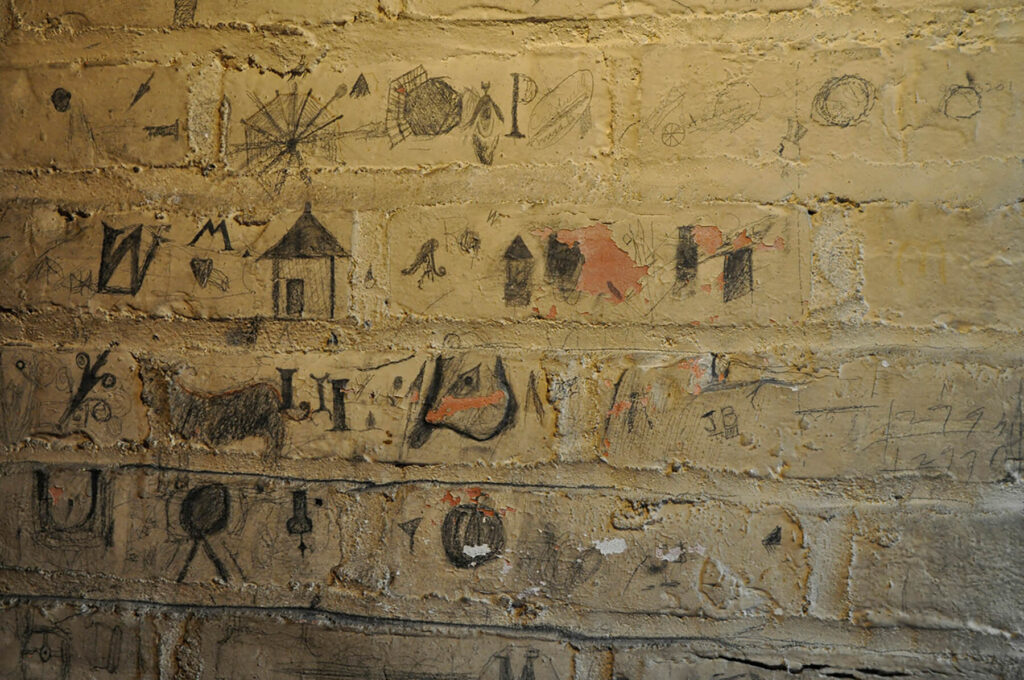
Inside, the offices, drafting rooms, copy rooms, and archives all suggested places of great activity and creativity. It felt like a fun place to spend your work day. The pencil doodles in the closet that acted as a phone booth spoke volumes of the relaxed nature of the place, whereas all of the built-in filing cabinets and drawers showed the complexity of what they were up to.
The size of the work spaces gave me a sense of the quantity and scale of the projects the firm took on. When I learned that the office wing more than doubled in size after the senior Olmsted retired in 1895, it helped me understand the scope of what he was trying to achieve. Ensuring his work and principles survived him, he was aiming for a generational impact.
The photo archive room inspired me the most. It’s a small space lined with hundreds of individually numbered drawers. Each contained an album with all the images from the thousands of projects they worked on. It was the firm’s analog database, providing a visual catalog of their work. Now, it’s a rich archive you can view online, but since Fairsted was turned into a museum, the comprehensive record hasn’t been updated in decades. To a degree, I like to think I’m continuing that work, documenting the parks today.
3. This is your second book that highlights an Olmsted landscape through a series of panoramas. What makes you passionate about capturing historic landscapes in this way?
Panoramas capture more than a glimpse of how a place looks. Documenting the entire environment, they capture the feeling of what it’s like to be there.
Unlike traditional media (photos, videos, plans), panoramic images offer an interactive and comprehensive way to understand any given space. Like in a park, the viewer can decide where they want to look and and how long they want to linger. Given that Olmsted designed his parks to be 360-degree experiences, approached from all directions, panoramas seem ideally suited to capturing his work.
To photograph an individual panorama, I plant my tripod down on a path and I take pictures in a complete circle. I do this three times: once along the horizon, once pointing up, and finally again pointing down. I download these images (between 60-100 photos) and stitch them together on my computer into a single, extremely high-resolution 360-degree image. This process reminds me a lot of the excitement with processing analog images in traditional photography—I don’t really understand what I’ve captured until the panorama is assembled. Often I’m delighted to discover details and compositions I hadn’t noted when I was in the park, snapping away.
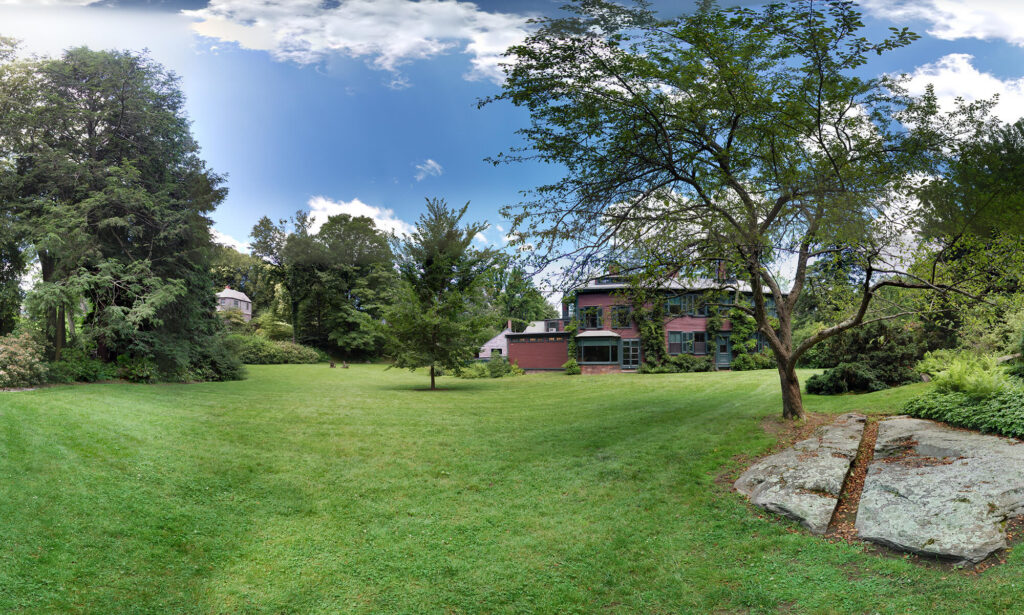
My tours consist of a collection of dozens of panoramas, all linked together, following the key paths in the park.
On the computer, you can view the tours full screen, wandering wherever you want by pointing and clicking. For my print books, I’ve designed them to read like graphic novels, where instead of scanning sentences, you scan my panoramas. Turning the page, you progress through the space.
“World’s End” in Hingham, MA was the subject and title of my first Olmsted book. (Though enjoyed and maintained as a park today by The Trustees of Reservations, the landscape was designed by Olmsted to be a housing development.) That book was meant, in part, as a proof-of-concept for this larger goal. “Fairsted” is intended as the first in a series of photo books documenting the parks Olmsted designed after the Civil War. Next up will be a book devoted to Fort Greene Park in Brooklyn.
I hope my tours will inspire people to visit the real places and that park conservancies can use these images as a benchmark for planning and taking on future environmental challenges.
4. You connect Olmsted’s work at Fairsted to broader themes of democracy and civic life. How did you arrive at that interpretation?
From a really early age, I connected Olmsted to designing democratic spaces.
Visiting playgrounds as a kid, my mom told my brother and I that Central Park was built especially for us and everyone who went there. That idea blew my toddler mind. The park was mine! It was a fantastic place, but I really got a kick out of the unlimited supply of new and interesting children there to play with. All of them co-owners.
As a teenager, I sometimes wondered—besides voting in elections—what made living in a democratic nation different from living elsewhere? Olmsted, I learned, wondered about this too. Especially after extensively traveling in England, Europe, and the deep American south, he had a lot to say on the matter. The conclusions he came to in his later writings—and which are embodied in his public park design—move me deeply.
In a nutshell: more than a political system, he saw democracy as a way of life we all struggle to achieve. Seeing and treating others as equals isn’t easy, and modern living grinds this impulse down. When we leave our homes and meet together, though, face-to-face with strangers in a common outdoor space, a sense of togetherness can be found that’s nowhere else. Parks provide a stage for democratic life.
To me, Fairsted represents the triumph of Olmsted’s vision. It’s the place where these ideals were made tangible as parks for generations to come, and it’s a place where he trained apprentices to continue his work after he was gone. When I’d finished my photo shoot, though, I found myself tongue-tied trying to describe Fairsted’s importance to others.
Many people only know Olmsted through his work on Central Park, his first project. As a student of his writings, though, I knew that Olmsted’s best essays describing his democratic ideals didn’t come until much later in his life—such as when he was living in Brookline. To explain Fairsted’s importance, I wanted to explore Olmsted’s evolution of thought. I wanted to show how he went from a one park man to someone who was building them across the country and teaching others how to continue his work.
One event, in particular, drew my attention. In 1861, ill and depressed, Olmsted quit Central Park, declaring he would never return to landscape design. I wanted to show how and why Olmsted eventually changed his mind so completely. When Ethan Carr and Rolf Diamant’s book, “Olmsted & Yosemite” came out in 2022 (illustrating how FLO was also responsible for the National Park idea), it redirected my attention to Olmsted’s time in California during the Civil War.
The essay in my book, “Olmsted’s Lost Years,” describes how several factors combined to help him envision devoting the rest of his life to building parks. Key among them were a difficult heart-to-heart correspondence with Calvert Vaux and an epic family journey to Yosemite in 1864. Camping in the mountains, days from any town or road, the Olmsteds were not alone. They found themselves camping alongside native American families. Their children played together. Despite massacres happening across the West at the time, for six weeks in Yosemite, families who were strangers to one another in every way found common ground. The reason Olmsted spent so much energy afterwards expounding on the value of spending time in the wilderness was because of the profound effect it had on him. It’s where he and his family found relief and healing from the pressures of their war-torn world.
5. Olmsted’s legacy is interpreted in many different ways today. How do you see your perspective fitting within that broader conversation?
To me, it’s Olmsted’s parks that matter most. I want to document them, report on their condition, and celebrate their beauty and importance as living, thriving sanctuaries. I’m interested in Olmsted as an artist and human being who, as part of a broader parks movement, had the vision, passion, tenacity, and talent to make the world a better place.
I believe too often the broader conversation frames Olmsted’s life in terms of career, claiming his major achievement was that he sired a profession. Instead of career goals, though, I see him as being guided by a passion to help American democracy recover after the Civil War. As an artist, he found a way to fix a broken nation and make people’s lives better. To me, the degree to which he succeeded is a huge cause for hope now.

Mark Roessler previously served in a communications role at the Olmsted Network, and now pursues independent writing and photography projects, including panoramic tours on Panorambles.com. His book “Fairsted: Reflections on How Olmsted Helped Heal a Fractured Democracy” is available from Levellers Press.