

In 1981, I attended the dedication of Fairsted—Olmsted’s home office in Brookline,
Massachusetts, a National Historic Site. That occasion sparked the inaugural national
conference of the National Association of Olmsted Parks, today’s Olmsted Network. As a young landscape architect, I moderated the session on landscape restoration. Landscape preservation and landscape history were in my blood. So was Olmsted—who had designed the prep school I attended, as well as Stonehurst, the estate of a distant relative. And so was China. In 1976-7, I had spent a year with the Taiwan Tourism Bureau (China itself was not yet “opened up.”) I had focused on cultural landscape preservation and found time to learn traditional Chinese landscape painting.
Fast forward three decades. After raising three children, my career took me to AGER, a
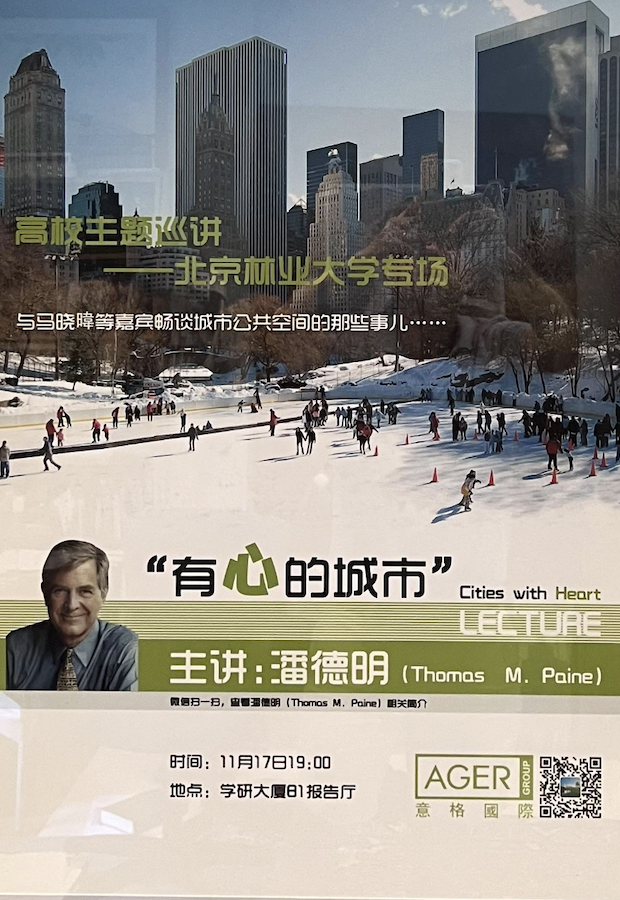
Shanghai-based landscape architecture firm where I authored a book on urban green space planning and design best practices. The heavily illustrated and bilingual Cities with Heart was published by the China Architecture and Building Press in 2015. For its cover, I chose an image of Olmsted’s Central Park. In China, that was probably the most famous park in the world—and for a good reason. It was a people’s park, and the large urban parks that had been emerging in communist China were often dubbed the Peoples Park.
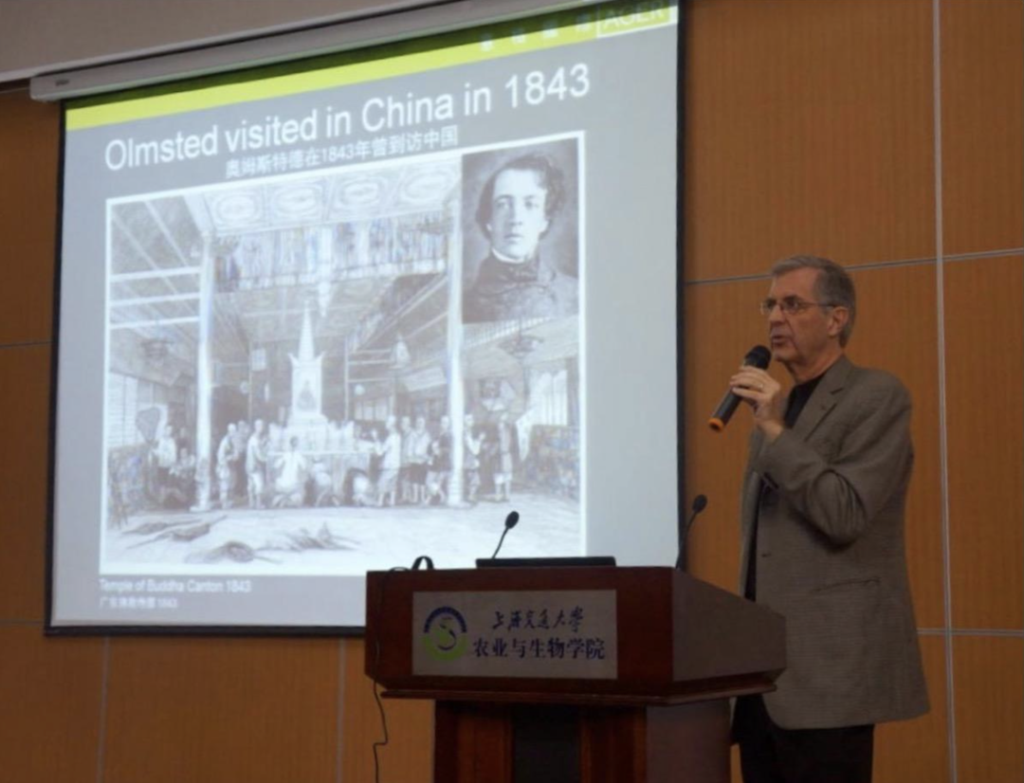
Just as the book was going to press, an entrepreneur from Guangzhou (formerly known as Canton) asked me to lead a delegation from Boston to commemorate the first direct American Chinese contact that had taken place in 1784, when the Boston-built merchant ship Empress of China dropped anchor in Canton. At the Mayor’s banquet for the delegation, totally unprepared and unrehearsed, I spoke about how Olmsted’s visit to Guangzhou in 1843—as a 21-year-old common sailor, whom local people welcomed into their shops, temples, and even homes—significantly inspired his vision 15 years later of parks for the people, when he entered the competition to design Central Park. Mayor Chen loved my remarks so much that they got coverage in the Guangzhou Daily news for two days running.
Here is what Olmsted vividly recalled:
We roamed wherever inclination led us…often interrupting men and women at their work,
into shops and factories, boatbuilding yards and potteries, gardens, cemeteries and houses
of worship, even into private houses; seldom receiving the rebuffs and rebukes which I
am sure we deserved, often invited and assisted to gratify our curiosity…This good-
natured disposition was, as far as I can remember, universal. We met, to be sure, few
but the poor and lowly, yet we occasionally encountered some of the more fortunate…I
suppose that civilization is to be tested as much by civility as by anything else,
and…these incidents…made a strong impression upon me.
In 1858, that memory of civility in China helped inspire his dream of creating parks for the
people, so people of diverse backgrounds could share life.
Walden author Henry David Thoreau may never have made it to China, but he did read Chinese Daoist philosophy in translation—and that spirited him on his journey as the father of the modern environmentalist movement. That link, too, speaks to the interconnectedness of Olmsted’s core values and Asian aspiration. Yes, we are more connected than we think.
Thomas M. Paine is a retired landscape architect who lives in Wellesley, MA. Check out his
website Netizen Tom Paine’s Common Ground at tmpaine.net.