
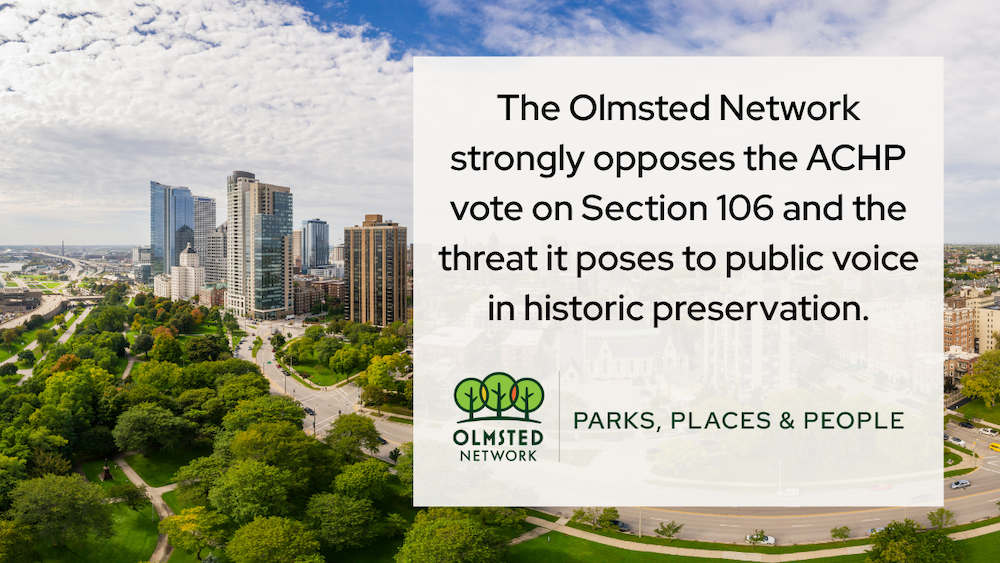
The Olmsted Network strongly opposes the proposed revisions to the regulations that guide implementation of Section 106 of the National Historic Preservation Act. On July 24, the Advisory Council on Historic Preservation (ACHP) voted to advance these revisions as a Notice of Proposed Rulemaking, after giving Council members barely a week to review a near-complete rewrite of the regulations. The draft now heads to interagency review before it’s published in the Federal Register and the public comment period opens. The proposal would make public input optional and narrow what counts as worth protecting — including the full range of places at the heart of our mission, from parks and parkways to college campuses and cemeteries. The scale of what’s being proposed means our partners and supporters should know now: we oppose these changes, and we intend to fight them.
As the national voice for Olmsted parks, places, and principles, the Olmsted Network knows that historic places—from buildings and bridges to parks, parkways, and the communities built around them—aren’t relics to be managed out of the way of development. They’re working infrastructure for public health and climate resilience, managing stormwater, cooling neighborhoods, and cleaning the air we breathe. Section 106 is one of the few tools that guarantees the public has a voice before that infrastructure is altered or lost.
For nearly 60 years, Section 106 has required federal agencies to reckon with the impact of their projects on historic places—buildings, landscapes, archaeological resources, and places of cultural and traditional significance. The current proposal would narrow the definition of what even counts as a historic property, favoring sites that are small and self-contained. That change lands squarely on our work: park systems and parkways, for example, are expansive and connective, not compact—and a narrower definition would leave many of the places Olmsted and his successors designed with less protection than they have today. These landscapes also rarely hold a single history — Olmsted designs frequently coexist with other cultural and ecological histories layered into the same place, and preserving the whole means preserving all of those layers, tangible and intangible alike.
The proposal doesn’t stop at what counts as a historic place — it also narrows what counts as harm to one. As the Cultural Landscape Foundation has noted, the standard would focus on material damage and physical alteration alone, leaving out the setting, feeling, and sense of place that landscape design depends on. A parkway doesn’t have to be demolished to be ruined; a severed view, a fragmented route, or a lost sense of continuity can undo the very qualities that made it significant in the first place. We are especially concerned that this shift reflects a broader trend of weighing historic preservation against other priorities, like economic development, rather than protecting it as a value in its own right. This is not a technical fix. It is a decision about which places, and whose histories, are erased without a fight.
None of this is abstract for us. History shows what happens when the legal guardrails requiring review—whatever form they take—get thinner. The Olmsted Network is currently part of a coalition suing the Trump administration for neglecting legally required review in West Potomac Park. We’ve seen this pattern before, in different forms — public parks and natural lands quietly ceded to private interests, public process treated as optional. This is that same pattern, applied to the review process itself. It’s not the first time a historic place has paid the price for decisions made without the public having a real say, and it won’t be the last unless these processes are protected and respected.
That’s what Section 106 protects: a conversation the public is entitled to have. It ensures communities, Tribal Nations, preservation advocates, and local governments have a real voice—not a courtesy notice—in decisions that affect the places they care about. It has never stopped progress or required that places stay frozen in time; it has required that decisions be made in the open, with alternatives considered and communities at the table. Making that consultation optional, as this proposal would, does not remove an obstacle. It removes the public.
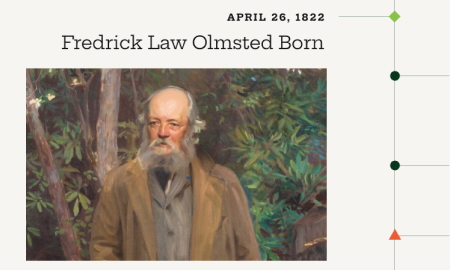
These principles are inseparable from the Olmsted legacy. Frederick Law Olmsted, his sons, and the Olmsted firm believed that thoughtfully designed places could strengthen communities and create shared spaces accessible to all—not as a luxury but as a public good, an idea Olmsted argued for as early as his 1865 Yosemite Report. But Olmsted’s influence reaches well beyond the landscapes that carry his name — his ideas shaped how Americans think about shared public space itself. And the stakes here go beyond Olmsted, too. This is about whether we, as a society, continue to value the layered histories held within our everyday places, or whether we let them be quietly stripped away.
The Olmsted Network stands firmly opposed to any revisions that reduce transparency, limit meaningful consultation, or narrow protections for the places communities value. We will not treat this as a routine regulatory update.
As this rulemaking moves through federal review, the Olmsted Network will continue to follow it closely, weigh in when the comment period opens, and stand with the coalition of preservation, Tribal, and community organizations pushing back. We encourage you to stay informed and get involved now by contacting your representatives. Read more from these trusted sources: