
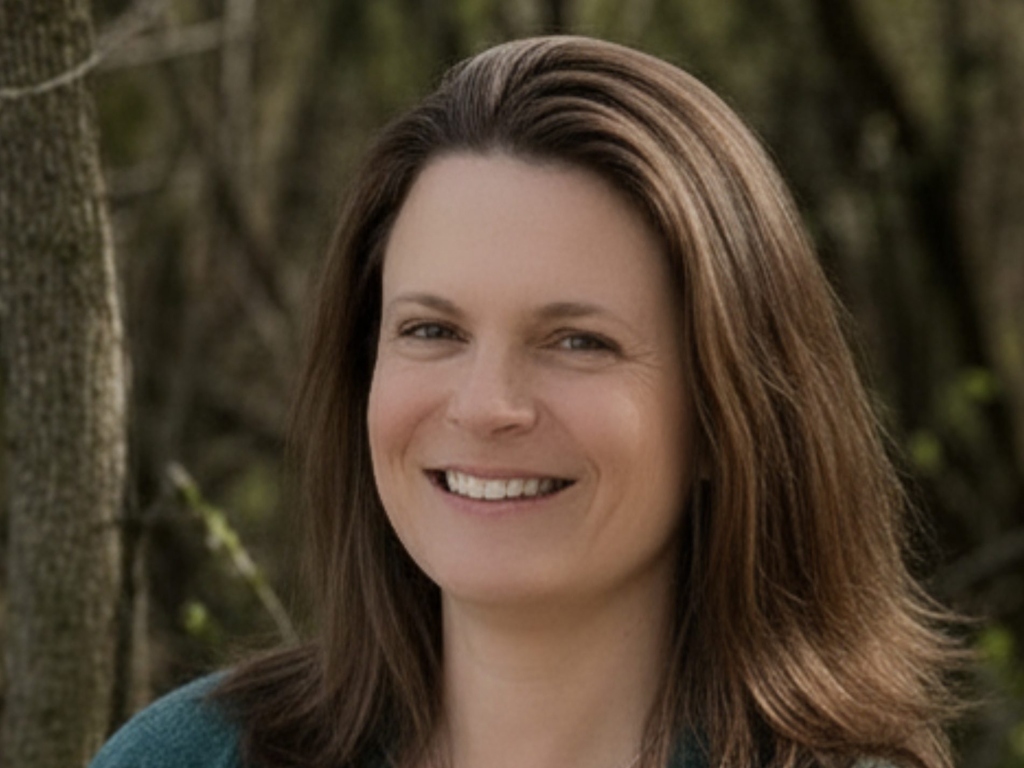
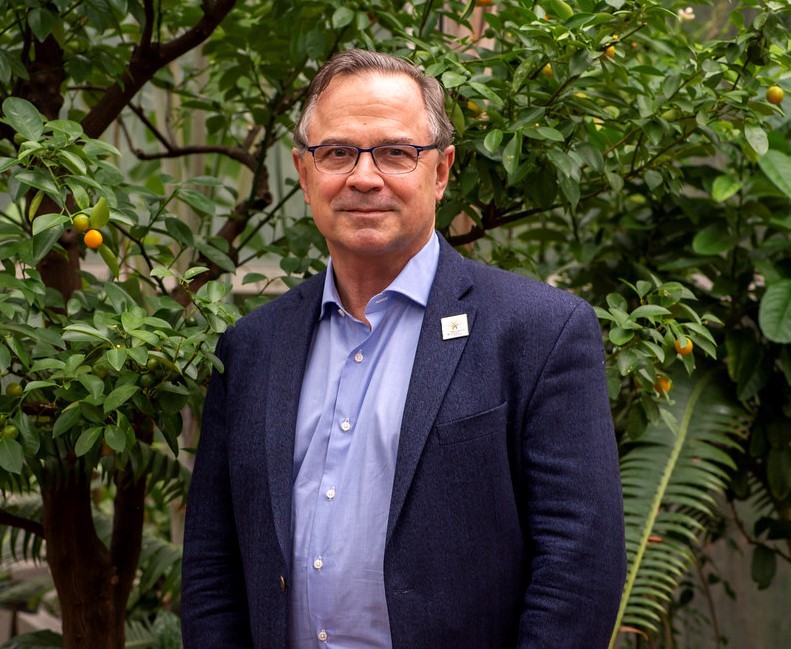
Adrian Benepe has been involved with Olmsted parks and landscapes for more than four decades. Winner of the Olmsted Network’s first-ever President’s Award in 2022, the former New York City Parks Commissioner now joins the Fort Tryon Park Conservancy as its first Managing Director & Chief Development Officer.
In a recent conversation with the Olmsted Network, Adrian traced his career in Olmsted landscapes from his teenage years to now.
Describe the career journey that brought you to Fort Tryon Park Conservancy—from NYC Parks and Recreation to Brooklyn Botanic Garden.
I have spent nearly all of my 48-year career in government and the non-profit sector focused on parks and open space, and related fields including historic preservation, public art and monuments, arts & culture, and planning and the environment. I started as a seasonal park cleaner as a teenager when the parks of NYC (including the once-great Olmsted parks) were a disaster area, then was part of the first municipal Urban Park Rangers program (based in Central Park) in 1979 in NYC—beginning a 27-year career at NYC Parks and Recreation. I served as Manhattan Borough Commissioner for NYC Parks 1996 to 2002 (helping to found the Conservancy at that time), and in my final 11 years I served as Commissioner of Parks for NYC. From there I went to the Trust for Public Land, overseeing urban park programs nationwide for 8 years, followed by 5 years as President and CEO of Brooklyn Botanic Garden— designed in 1910 by the Olmsted Brothers firm. In fact, for my entire career I have been involved with Olmsted parks especially in NYC, but also across the nation. Now I take on running the Conservancy, saving as the first-full-time leader in its nearly 30-year history.
Fort Tryon Park was designed by the Olmsted Brothers, and is one of several landscapes in Manhattan designed by the Olmsted firm. What sets it apart from New York’s other famous parks?
When John D. Rockefeller hired the Olmsted Brothers firm in 1927 to turn the 200-foot-tall-mountain of rock and former CKG Billings estate into a park as a gift to NYC residents, Frederick Law Olmsted was the sole principal, as John Charles Olmsted had died 7 years earlier in 1920. It appears that Rockefeller gave Olmsted carte blanche to build a medieval castle/Bothers Grimm fantasy landscape overlooking the Hudson River, with sweeping views of the New Jersey Palisades (that Rockefeller also helped preserve as part of the Palisades Interstate Park) and of the deeply wooded park just north, Inwood Hill Park. What I have discovered, even after knowing Fort Tryon Park very well for more than 30 years, is that it is by far the best preserved “original” Olmsted design in NYC—perhaps the best-preserved Olmsted landscape in the nation. I base that on the fact that the design as built and opened in 1935 is remarkably intact, with nothing significant added or subtracted since the day it opened. In 1983 when NYC Landmarks Preservation Commission designated it as a “Scenic Landmark,” the LPC historian Jay Shockley wrote in concluding his lavishly researched designation report: “Although some of Fort Tryon Park’s planting designs have been somewhat obscured by years of unmanaged growth, the park survives today in unaltered form as an outstanding work of the firm of Olmsted Brothers and one of New YOrk City’s most significant parks.” Forty-three years later that is still true.
As Fort Tryon Park Conservancy’s first full-time leader, what is your vision for the future of the park?
I helped create the Fort Tryon Park Conservancy (first known as the “Fort Tryon Park Trust”) in 1998 with the enthusiastic support of neighborhood resident, the late Dr. Ruth Westheimer. Building on the great early volunteer work of the Friends of Fort Tryon Park, who worked with the first Adminstrator of North Manhattan Parks, Jane Schachat, we built a small but devoted board that included Rockefeller’s great-grandson Joseph Pierson, landscape architect Nicholas Quennell (who led the restoration of the centerpiece Heather Garden in the 1980s), and Tom Kissinger, nephew of famous Washington Heights resident Henry Kissinger. The board has evolved and grown over the years, under the aegis of Schachat’s successors, Jennifer Hoppa and Jana La Sorte, and it is now very ably chaired by Jeff Bauml, who grew up in the neighborhood. This park is beloved by all its neighbors in Washington Heights and Inwood, and as the home to the Met Cloisters Museum (also created and funded by Rockefeller), it draws visitors from the region, the nation, and around the world to see its globally renowned collection of medieval art and architecture, including the famous “Unicorn Tapestries” and the architectural remnants of five European cloisters.
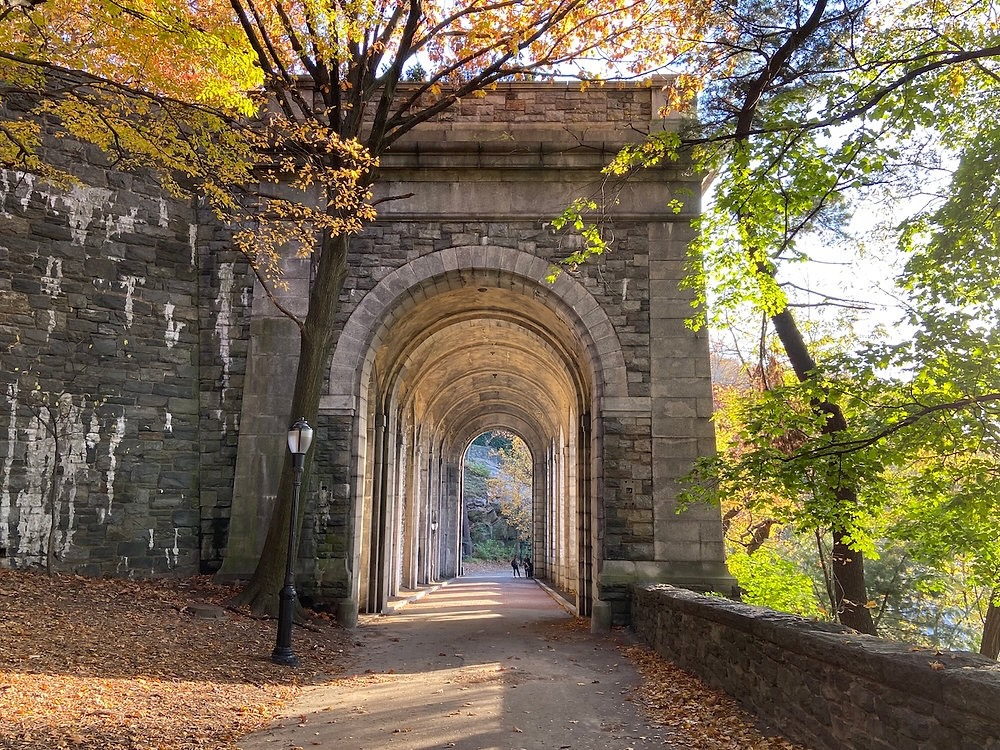
The board has several priorities, including illuminating the fantastic architectural edifice down as the Billings Arcade, that predates the park, adding handrails to the many very steep stone staircases that characterize the rugged, rustic landscape and continuing the restoration of the paths, stairs, and other infrastructure of the park. A major focus of the next few years will be the creation of a “Woodland Restoration and Management Plan,” to address the care and replacement of the thousands of major trees in the park and open up vine-covered landscapes and vistas, while enhancing habitat for birds and other wildlife, as well as restoring and repurposing two vintage stone structures that stand in the park and which have been sealed for decades,
Do you have a favorite spot in the park?
There are so many magical, mysterious spots and features of the park, but one of them is the area around the recently restored Alpine Garden along the eastern slopes of the park near Broadway. This romantic setting includes half a dozen elfin staircases—some no wider that 12 inches—that ascend the rocky slopes between lush plantings maintained by the park’s amazing gardeners—two funded by the Conservancy. Jana La Sorte refers to these as “Fairy Stairs,” and that name may stick! I also love the fact that an elevator (within the A Train subway station but open to the public without paying a fare) rises from the base of the park at Bennett Ave, nearly 200 feet to its peak at the entrance to the park at Margaret Corbin Circle, named for a heroine of the American Revolution who was injured in the final battle in NYC in November 1776—the “Battle of Fort Washington”—whose 250th anniversary will be celebrated November 15 with a reenactment and other activities.
What are some of the exciting changes underway at Fort Tryon Park?
We are making Walter Sorel, one of our part-time staff, full-time (in addition to me as the first full-time leader of the Conservancy), to enhance programming and marketing and communication, we are continuing vital work on restoring stone ramparts and retaining walls, and we are creating the framework for the very exciting, game-changing “Woodland Restoration and Management Plan,” which will see Fort Tryon Park into its centennial in 2035 and well into its second century.