


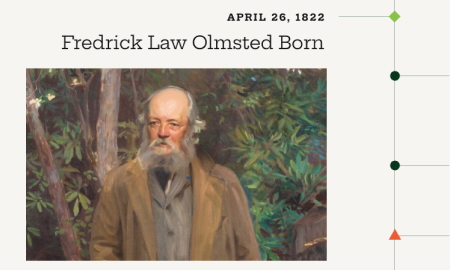

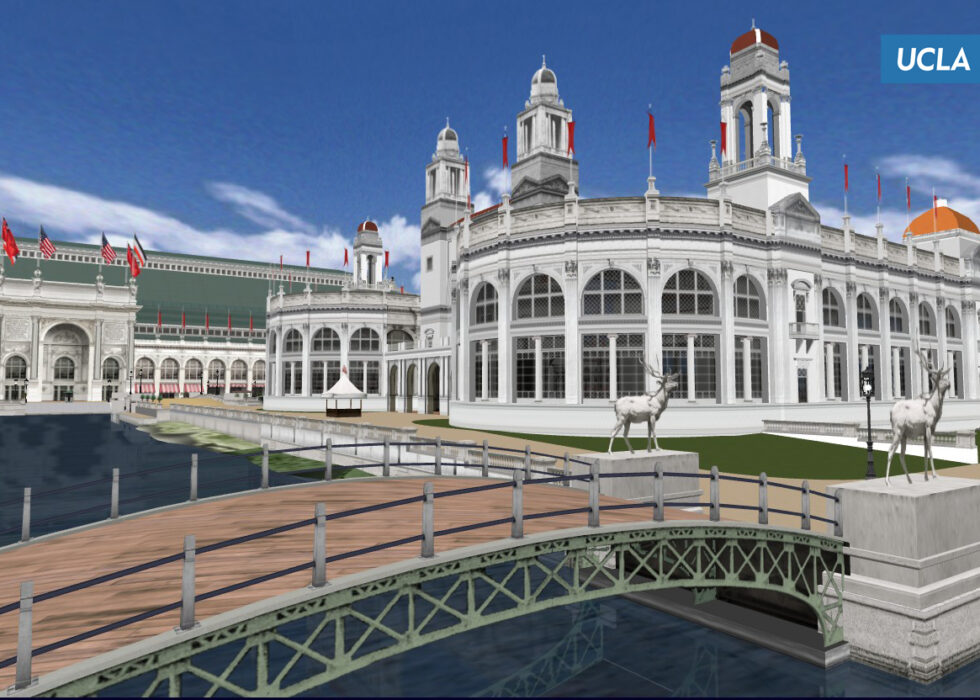
This webinar explores Chicago’s World’s Columbian Exposition of 1893, one of Frederick Law Olmsted’s most famous projects. As landscape architect, Olmsted joined Director of Works Daniel H. Burnham and a veritable who’s who of American architects at the end of the nineteenth century to conjure up an ephemeral city from the muddy marshlands of Jackson Park. During the fair’s six-month run, over 27 million people from around the globe strolled through the Court of Honor, explored the massive exhibition halls, and marveled at the spectacle that was the Columbian Exposition.
For nearly three decades, Dr. Lisa M. Snyder of UCLA’s Office of Advanced Research Computing has been working on an interactive computer reconstruction model of the World’s Columbian Exposition that allows modern audiences to experience the fair in a way never before possible. With an emphasis on veracity, the model draws on source material gleaned from digital and physical archives (including the Ryerson and Burnham Library at the Art Institute of Chicago and the Olmsted Archives at the Frederick Law Olmsted National Historic site in Brookline), contemporary architecture and engineering journals, historic photos, text descriptions, artists’ renderings, and newspaper articles. Dr. Snyder will discuss the history of the fair, her reconstruction process, and give attendees a brief virtual tour through her reconstruction model.
About Lisa Snyder
Lisa is the director of the Computational Research Technology Groups for UCLA’s Office of Advanced Research Computing. As a scholar, she is an architectural historian with a Master of Architectural History from the University of Virginia and a Ph.D. in Architecture from UCLA. Her primary research is on pedagogical applications for interactive computer models of historic urban environments. In addition to her work on the World’s Columbian Exposition, she also developed the reconstruction model of the Herodian Temple Mount installed in 2001 at the Davidson Center in Jerusalem and expanded the project in 2007 with a reconstruction of the early Islamic structures on the site during the eighth century. With funding from the National Endowment for the Humanities, Lisa also led a team to develop VSim, a software interface that provides users with the ability to craft narratives in three-dimensional space as well as the ability to embed annotations and links to primary and secondary resources and web content from within the modeled environments. With Elaine Sullivan (UCSC), Lisa co-authored “Digital Karnak: An Experiment in Publication and Peer Review of Interactive, Three-Dimensional Content,” in the Journal of the Society of Architectural Historians, which used a 3-D reconstruction of the ancient Egyptian temple complex as the basis for a publication prototype.
By registering for this event, you consent to receive occasional emails from the Olmsted Network.