


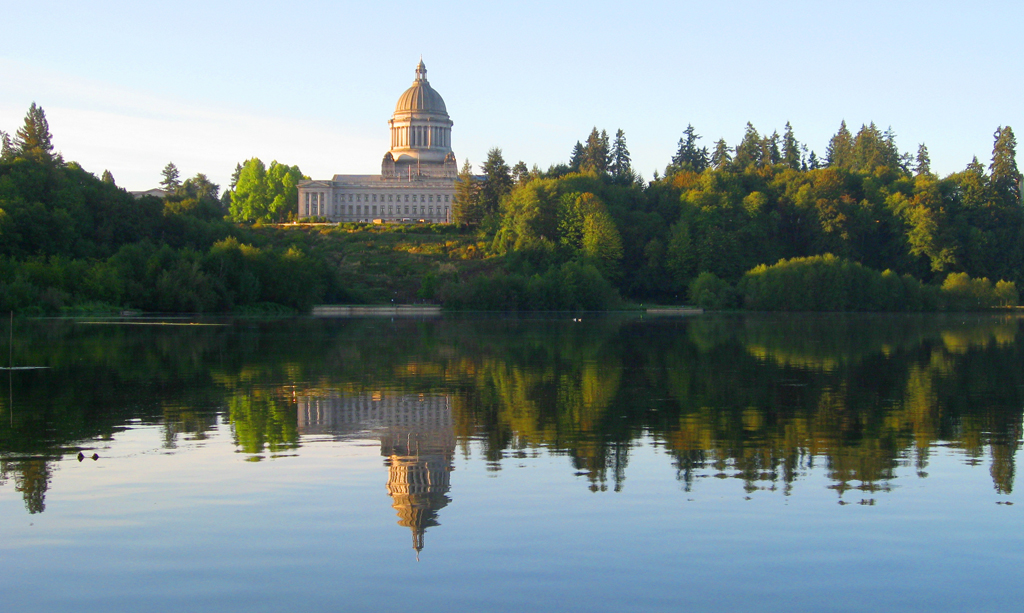
About Washington State Capitol
Intentionally situated on a forested bluff above downtown Olympia, the Washington State Capitol grounds are a lasting expression of Olmsted Brothers’ approach to landscape design.
John Charles Olmsted first visited the Capitol grounds in 1911, meeting with the governor and Capitol Commission. That same year, he prepared initial plans for the site, helping establish the framework for what would become an ambitious landscape surrounding the state’s new center of government, with a goal of connecting the Capitol buildings to the surrounding landscape and the broader Pacific Northwest. The central Capitol legislative building, designed by Wilder & White, was completed in 1928, and thus the landscape construction was delayed for nearly two decades after John Charles’ first visit.
In 1927, landscape architect James Frederick Dawson of the Olmsted Brothers firm returned to the project and led the completion of the grounds until 1931. Working within the firm’s earlier plans and the architectural framework established by Wilder & White, Dawson helped shape a 54-acre campus.
The result reflects a distinctly Northwestern sense of place. Major and minor axes create a clear spatial hierarchy, while layered vegetation defines a sequence of outdoor rooms and frames carefully composed views. From the campus, the landscape opens toward Puget Sound and the Olympic Mountains to the north and west, with Mount Rainier to the east, extending the experience of the Capitol beyond its buildings and grounds to the larger geography of the state.
Listed on the National Register of Historic Places in 1974, the Capitol Campus retains much of the original Olmsted Brothers design framework. Recent modernization efforts have grappled with the challenges of how the campus can adapt to contemporary needs while preserving its historic landscape, including its spatial relationships, vegetation, and views. More than a century after Olmsted’s first visit, the Capitol grounds demonstrate the lasting value of the Olmsted approach and the vision of civic life.