

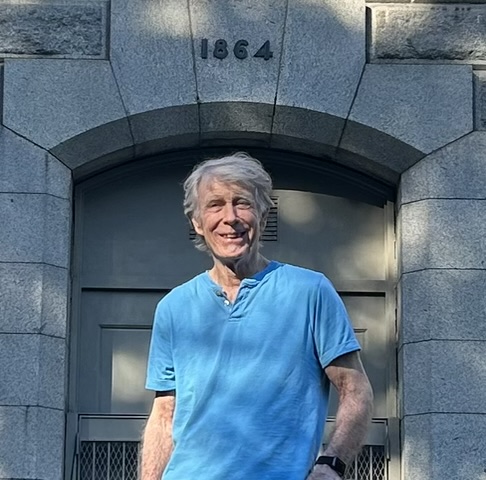
David Morris is the author of Ten Thousand Central Parks: A Climate-Change Parable, a book from Fordham University Press that explores the creation of Central Park as an urban success story inspiring bold climate action. Through the lens of urgency and optimism, the book offers a fresh perspective on how green spaces like Central Park can combat the climate crisis. The Olmsted Network recently sat down with Morris to discuss his work.
Your bibliography is wide-ranging, from works on eighteenth-century studies to several books and essays on the medical and cultural implications of pain and illness. What drew you to write about Central Park?
Central Park for six years was my backyard. I lived right across the street and started almost every day with a four-mile walk that included circling the Reservoir. Today it’s easy to regard the park as just another outsize tourist landmark in the Big Apple. In fact, Central Park gets some 42 million visitors a year—more than all the famous New York theaters and museums combined. I felt driven to know how this 843-acre wonder came to occupy the heart of concrete-and-steel Manhattan. As if rubbing my eyes after a long sleep, I wanted to ask not just how it happened—from a historical perspective—but also, like a child at a magic show, how on earth could it happen?
The questions opened space for a meditative excursion into narrative nonfiction, which is what I do. As I learned about its actual nineteenth-century origins, I began to wonder what resources Central Park might offer today we navigate the troubling new era of climate change and climate denial? Are we really, as some pundits say, doomed?
The book offers a hopeful approach to confronting the climate crisis—using Olmsted’s Central Park model to capture carbon and improve quality of life in cities all over the world. Are Olmsted’s designs and ideas more important than ever in the 21st century?
Two observations. First, humans now increasingly live indoors and in cities. Americans spend 90% of our time indoors, according to the EPA, and another 6% in vehicles. Today 55% of people worldwide live in cities, and the UN predicts that by 2050 the number will rise to 68%. Second, when he applied to supervise crews clearing the ground for the proposed new park, Olmsted is broke and in debt, a farmer-turned-writer who badly needs a paying job. The young London-born architect Calvert Vaux persuades him to collaborate on a proposal that—the Greensward Plan—that wins the design competition. “I should have had nothing to do with the design of the Central Park,” Olmsted writes, “had not Vaux invited me to join him.” Only in middle age, after two more career changes, does Olmsted discuss the principles of park design. He begins as a rank amateur, minus theory or expertise, with a plan but few principles.
The single most important principle that I could extract from his later writings on public parks is surprisingly basic. Parks offer, he says, an “escape from buildings.”
We tend to take a disapproving view of escape, as in escapist fiction. Escape, however, also belongs to a language of liberation. It implies release from confinement, even if no more than a temporary throwing off of servitude or shackles. The park offers more than an escape from confinement, however. It offers a crucial escape into the natural world—woods, meadow, boulders, pond, streams, lake, and even wildlife—an urban asylum where nature and its healing properties are freely available to all. The term freely carries political significance. The escape from buildings is also the escape into a freedom that Olmsted and Vaux associate explicitly with the values of democracy.
Vaux described Central Park “the big art work of the republic.” I’ll come back to hope later.
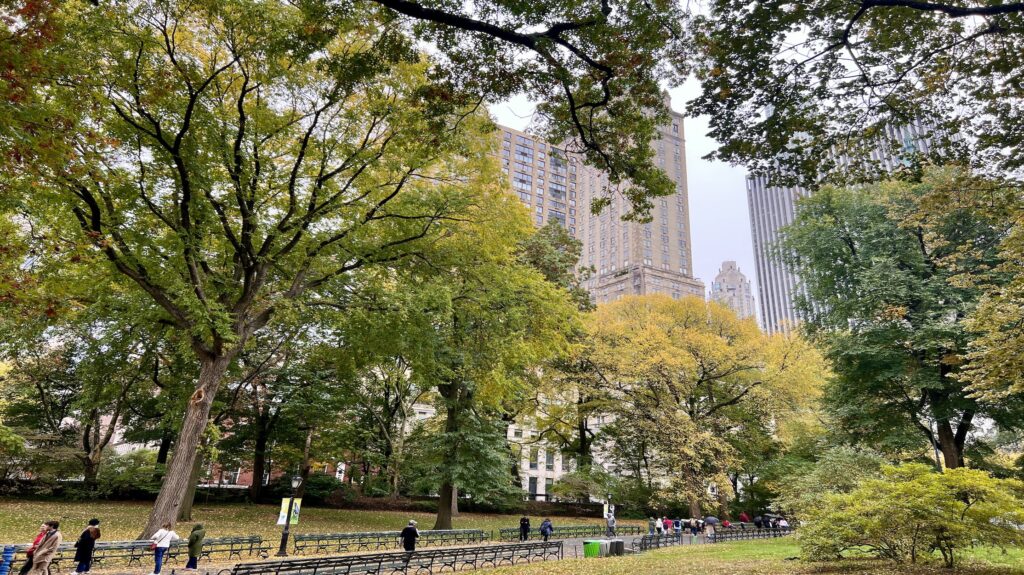
Central Park was born out of a tumultuous time in American history, amid rising tensions that soon boiled over into grueling civil war. Could such an ambitious project come out of the turbulence of our present day?
Hope is built into Central Park. How so? The park is constructed immediately before, during, and after the Civil War: a more turbulent and divisive period in American history is hard to find. Central Park thus demonstrates that despair and inaction are not the inevitable response to conflict and turbulence. The conflict that surrounds the park is not limited to wartime. Olmsted faces down a crowd of laid-off immigrant workers who hold signs reading Bread or Blood. One group carries a noose. The park in fact absorbs surrounding conflict—as in the dark and violent days of the 1970s—but parks can also offer contrasting images of peace. Nelson Mandela helps create the Peace Parks Foundation, dedicated to preserving stable ecosystems and social harmony.
Hope need not be reduced to wishful thinking. The philosopher Jonathan Lear proposes radical hope both as a moral virtue—a variant of courage—and as the jet fuel for creative action in the face of catastrophic damage. Climate change is already the source of worldwide catastrophes from thousand-year floods to killing heat waves. Hope and courage are both required if we are to act effectively in the face of disaster.
The subtitle of Ten Thousand Central Parks is A Climate Change Parable. Parables are complex stories that repay extended meditation, unlike fables designed to communicate a single tortoise-and-hare lesson. Central Park is of course more than a demonstration of what we can achieve in a dark time. I meet people from far-flung places who spontaneously tell me that they love Central Park. It makes sense to build on success. We don’t have to hang our heads in despair. Will we instead choose to roll up our sleeves, get to work, and build something that later generations will thank us for.
“The despair of inaction” is something that you try to rally against with your book. Why do you feel it’s so important to stay optimistic?
Hope is far more than a trait of human temperament that optimists possess and pessimists lack. Even pessimists can help build urban parks. We don’t give up because we despair; we despair because we have given up. Hope is an implicit refusal to give up, which some might say is a quality engrained in the American character.
Hope may spring eternal, as British poet Alexander Pope writes in An Essay on Man (1733), but Central Park suggests that effective action also embodies a quality of timeliness. The rapid movement of people into vast megacities creates a need for timely action. The distinguished environmental activist Bill McKibbin writes that Ten Thousand Central Parks makes “an intriguing argument”—timely too I would add—”that climate change turns the notion of ‘park’ into a necessity.” The implicit argument also highlights, explicitly, the time-centered importance of seizing the moment. There is a moment when Central Park is a possibility—but that window soon closes. There is a moment when Olmsted and Vaux are available to submit a plan for Central Park—in fact, they miss the deadline for submissions—and their collaboration is essential. Central Park not only demonstrates the value of collaboration. It also shows the value of timely consensus. The construction of the Park,” as a report put in in 1868, “has been easily achieved because the industrious population of New York has been wise enough to require it, and rich enough to pay for it.” Too simple, of course, but funding and consensus, like inventive collaborations, all possess real if invisible time-stamps.
Climate change is a huge and timely challenge, and it requires that we also think big. Central Park—843 acres in the heart of Manhattan—is a metaphor for thinking big.
What can individuals do to live out Olmsted’s environmental principles and make a difference in their own backyard?
Olmsted leaves Central Park in 1861, long before its official completion date of 1872. He is burnt out. He has spent three years almost nonstop directing a workforce that sometimes numbered over 4,000 and fighting over pennies with a cost-conscious board led by a commissioner who wants his job. Lincoln moreover asks him to run a large new civilian body charged with overseeing the health of Union troops in the Civil War. “A good big job,” he tells his wife in a massive understatement. He lasts two exhausting years as director of the US Sanitary Commission, traveling with a permanent limp from a carriage accident that nearly kills him—before burning out again. Eventually Calvert Vaux rescues him—his second rescue—this time luring him to help design Prospect Park in Brooklyn after Olmsted has taken a job in California as CEO of a gold mining company that soon declares bankruptcy. What can we—perhaps less hardly souls—do in our backyards against the planet-wide devastations of climate change?
- Partner up. Find like-minded colleagues who can help rescues us when we burn out or go astray.
- Think big. Take on projects that will make a difference for the future and that will outlive our limitations. Olmsted and Vaux designed Central Park to resemble a picturesque painting, but fortunately it looks nothing like that today. It’s far far better.
- Act boldly. Boldness has genius, magic, and power in it. Olmsted never lacks for boldness. It underlies the landscape magic of Central Park.We misread his genius, however, if we wait around hoping for a hero to resolve the climate crisis.
Moby-Dick may be the great American novel. Central Park is at very least the great American parable.
Ten Thousand Central Parks: A Climate-Change Parable is available from Fordham University Press.