
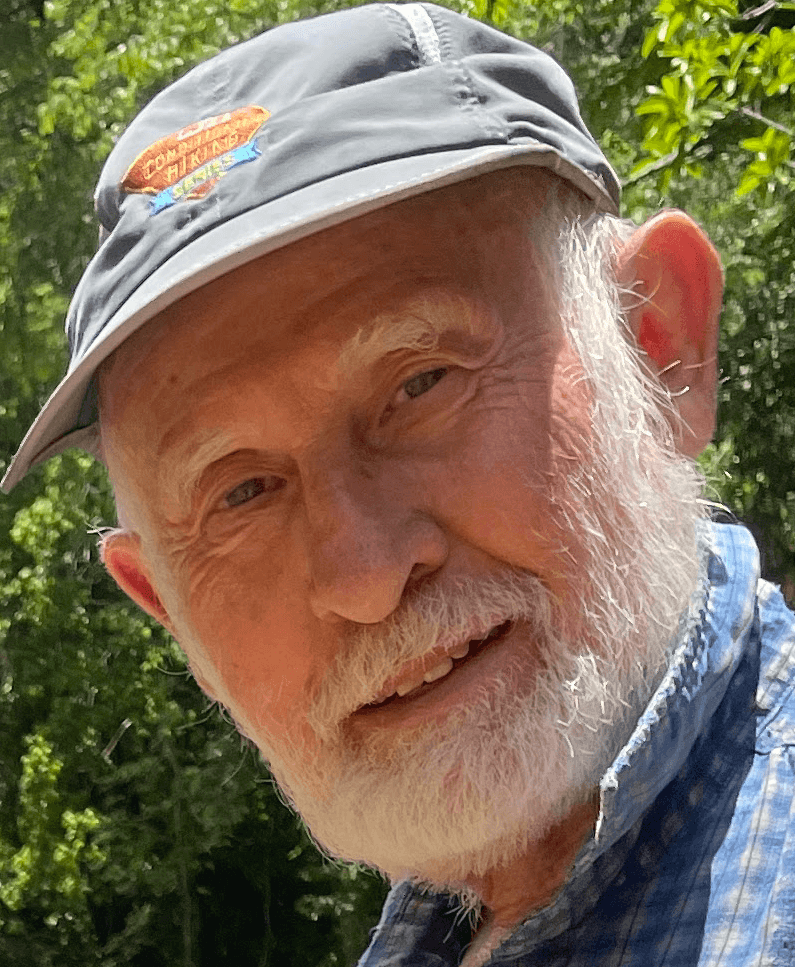
Peter Hendrickson is the author of Emerald City Trail: A Walking Guide Through Seattle & Our Olmsted History, a new book from Mountaineers Books that offers a new way to experience Seattle’s Olmsted parks. Hendrickson, an avid walker and historian, developed a 75-mile walking trail that highlights many of the city’s neighborhoods, parks, and landmarks. The Olmsted Network recently sat down with Hendrickson to discuss his new book.
You are an educator and medical researcher by profession, but you also volunteer with the Seattle Branch of The Mountaineers, a 17,000 member nonprofit organization that organizes outdoor activities across the PNW. Tell us how you came to be involved in this space.
The Mountaineers has had a space in my outdoor life for over 55 years. While teaching at Academia Cotopaxi (Quito, Ecuador) in the early 1970s, the 5,000 and 6,000 meter mountains at our doorstep called me to their glaciers, ridges, and summits. I was a rookie climber, but my Dad shipped me a rope, crampons, a parka, and the 3rd Edition of Mountaineering, Freedom of the Hills—the worldwide how-to climbers’ Bible. Decades passed with mountain adventures in Nepal, Europe, and along the PNW Cascades. I joined the club over 20 years ago, and backed off on the climbing, but went full steam ahead scrambling, paddling, navigating, and hiking. A now-and-then journalist, Mountaineers Books invited me to edit the first seven chapters of “Freedom 10,” the 2024 Freedom of the Hills edition. I’d ended my journalism and public school careers, and turned ongoing volunteer support for Latin American traumatic brain injury clinical trials into a University of Washington affiliate professor position. Work travel to Central and South America ignited follow-on mountain and river adventures.
Your bibliography predominantly covers topics like education and medical research. Do you think your background in those fields offers you a unique perspective on the outdoors?
We live on a small farm near Seattle—cows, chickens, vegetables, berries, fruit—and our travels are sweetest when we can take long treks in the mountains or the countryside to walk through farms, visit rural schools and better understand the joys and traumas that are realities for most of the world outside cities. For so many, life outdoors is a daily struggle for survival. How lucky we are to walk through their reality generally knowing a hot meal and comfortable room await. If there has been a crossover impact of education and medicine on my outdoors work, it has fueled a belief that doing (whether it be students making local maps or doctors developing consensus treatment protocols) is often more powerful than listening to others.
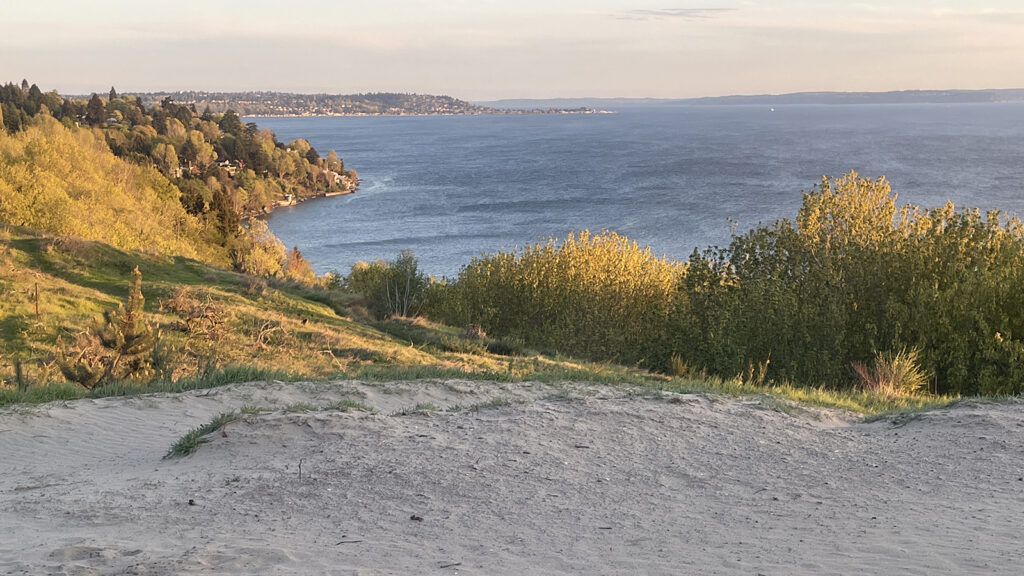
The book showcases a 75-mile urban walking loop throughout Seattle, featuring many landscapes designed by the Olmsted Brothers firm. Can you tell us about the origin of this idea and how you developed the trail?
Long walks—both urban and back country—have fueled my imagination ever since in childhood. I read history and adventure books with atlas in hand, imagining what was there on the ground as witness. I lived in Vancouver (WA) in the early 2000s and kept returning to Portland’s west hills to hike the trails network. Up the Columbia River I was hiking and climbing most weekends when not refereeing soccer. Mazamas, the Portland climbing club that helped launch The Mountaineers in 1906, hosted Tuesday and Thursday night two-hour walks to promote fitness for those weekend climbs. Like many reaching their 60s, there was a need to see if more difficult outings were still in my grasp and I twice completed day hikes of the 25+ mile Wildwood Trail. Returning to Seattle, I finally joined the Mountaineers and hoped to replicate those evening city hikes (now “urban walks”). By 2017 I was leading one or more a week through the Seattle hills with headlamped fellow walkers.
We frequently visited family in the Bay Area where we walked the San Francisco Crosstown Trail and Massachusetts, where we followed Boston’s Walking City Trail. SF trail evangelist Bob Siegel found me one morning in Seattle and easily made the case that our city also needed a long pedestrian trail. With scores of 5 to 30 mile walks already planned and led, it was a small jump to imagine a 50 km (30 mile) through route from a Puget Sound park in the north to the Rainier Beach neighborhood (where our grandchildren were in school) south along the Lake Washington shoreline.
Frequent test walks became Olmsted parks connectors when fellow walker Stuart Johnston alerted me to Friends of Seattle Olmsted Parks (FSOP) and their mash-up Google map overlaid with built or planned parks. I used a mix of city maps, Olmsted sites, Gaia and Google navigation apps, and years of experience to plan, walk, and revise, revise, revise with Mountaineers walkers. The 50 km became roughly 10km sections with start and mid-points that satisfied the “Three Ts” criteria: Public Transport, Public Toilets, and Treats. We put a premium on accessibility, a light footprint, and routes that non-expert navigators with moderate fitness could enjoy.
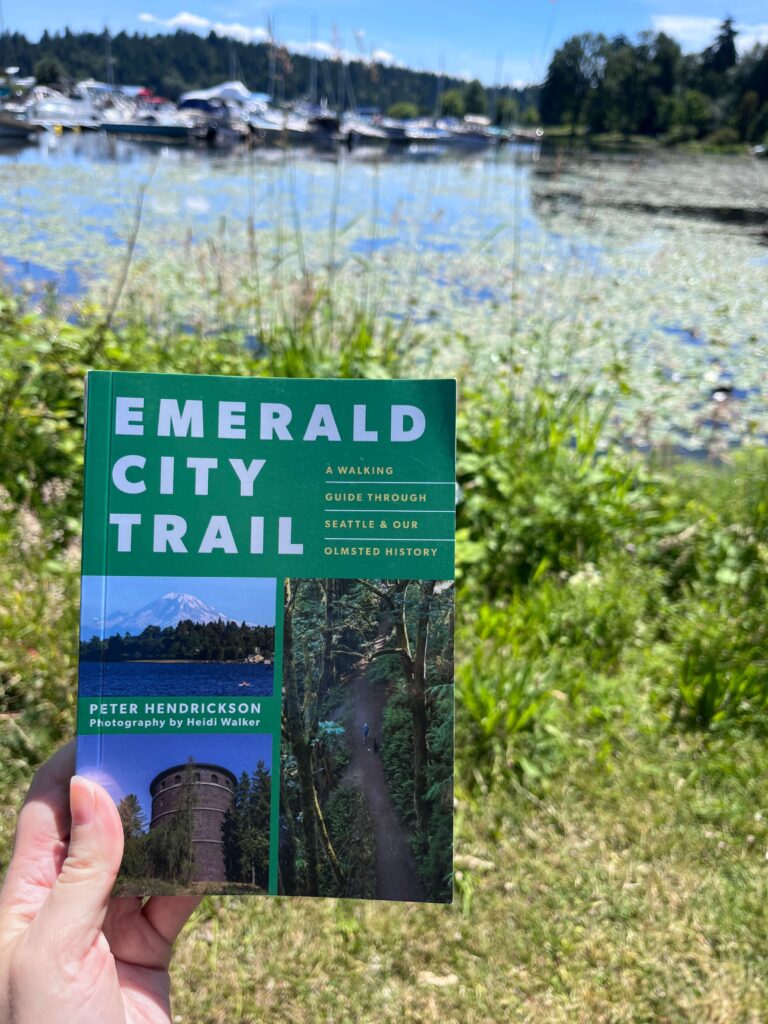
The Emerald City Trail provides a literal connection opportunity for people throughout Seattle, but there is also a figurative sense of connection in how it helps people to understand and appreciate the spaces in their own neighborhoods. How do you think of tours and trails as an opportunity to build community?
We don’t drive by, cycle by, or run by our yet-to-meet neighbors across the city. We walk by their apartments and houses. We stop to admire the views from their neighborhoods. We puff up and down the same stairs they take to make their way to work or to school. We make eye contact. We say “How ya doing?” to folks we pass. We ask about their yards and admire their dogs. As my granddaughter says, “Papa talks to everyone.” More often than not a show of interest in their lives is met with, at least, a short conversation. And many have fascinating stories to tell about their neighborhoods—the salmon rearing effort, the full size plastic pig over the fence, the new bistro a block away, the school they attended as a child… So often we hear from fellow walkers, “I’ve spent my whole life in the city and I didn’t know these three tunnels ran under the road here.”
The trail charts a path through existing green spaces as a contiguous loop, similar to other projects like the San Francisco Crosstown Trail and Boston’s Walking City Trail. Do you see trails like this becoming more popular across the country?
I would add the Walk Around Philadelphia to the mix of city colleagues who started with point-to-point long trails and then added longer, city circling loops. We chat regularly about our efforts to draw in trail makers from other cities and to more fully engage the disparate neighbors in our own cities. We feel that we are making major headways to activate the parks and boulevards laced through our cityscapes. In connecting neighborhoods, we hope that we are connecting neighbors. Compared to designing, acquiring right of ways, gaining public or municipal approval, constructing paths, and signing trails, our efforts are much lower cost, and time to completion can be months rather than years. For the moment, these initiatives fall a bit outside the scope of professional organizations devoted to parkways or back country trail work.
What do Seattle’s Olmsted parks mean to you?
I’m stunned anew each time I see a parks map from the early 1900s. The bones, the flesh and most of the sinews are yet there to walk, to play, to enjoy with family, friends and Mountaineers. Our volunteers advocate for continued maintenance and expansion of resources within the parks. Each of the 12 Emerald City Trail sections is walked regularly by pairs of Stewards assigned to their 10 kilometer (6 mile) through route and loop territories. Like them, I frequently post to the city’s Find It/ Fix It cell phone app to report problems on the routes–broken pavement, overgrown vegetation, trash, offensive graffiti, toilet needing repair… As citizen caretakers, we have a sense of shared ownership of these public places. We promote access via public transport. How many trailheads elsewhere have water taxi, state ferry, bus, and light rail transportation nodes at city trail junctions? We’re committed to full access to the parks and the trail that connects them.
Emerald City Trail: A Walking Guide Through Seattle & Our Olmsted History is available through Mountaineers Books, Amazon, Bookshop, Barnes & Noble, and anywhere books are sold. Learn more and plan your trip at emeraldcitytrail.com